I’ve interviewed over 50 CEOs for the Not Another CEO podcast. Each time, I ask the question:
What is one thing you’ve done, big or small, that has had the biggest impact, and that you would do again if you’re CEO of another company in the future?
Nearly half the answers are about defining, articulating, and reinforcing company values.
I hear this from CEOs of every type of organization: early stage startups, hypergrowth unicorns, non-profits and enduring enterprises. These CEOs have a shared understanding that – even more so than specific performance goals — defining and living organizational values is the best driver of team accountability and performance.
But I’ve also noticed that many founders and CEOs treat values as an afterthought. They may not even write them down (admittedly we did not take the time at my first two companies). When my co-founder Nick, previously theCEO of Workstream.io, read an early draft of this post, he wrote to me:
At Workstream, we never did a values exercise despite having worked with you on the project at BetterCloud. I thought about it a bunch, but it never made it to the top of my list. I figured we had more important things to obsess over, and because our team was small and I worked directly with everyone.
I get Nick’s point: Founders/CEOs are busy, and because everyone works in close proximity, you believe that your personal values will be absorbed by osmosis.
But, if you don’t write down and reinforce your values, as the team grows your values will drift and people will start modeling the wrong behavior. When founders do write them down, I see that they often choose words that are generic or just matter to the CEO. These values are not meaningful to the larger team, or relevant to their customers. Teams often roll out values once, and then never refer to them again. They don’t incorporate them into management, or do anything to recognize those who embody your values. More often than not, company values are just an afterthought.
Company values should guide everything you do, and serve as your north star. They become the key filter for every decision, and anchor everyone on your team. Your company values should actually be the heart of your business, and fuel everything your organization does.
Here are some broad themes that I see emerging time and time again among CEOs who have invested deeply in company values. The most powerful values are:
Authentic: Your values need to be authentic to your entire company, and not simply pushed down by the founders. They must be defined and agreed upon by your larger team, reflecting your goals, customer and mindset.
Memorable: The wording that you use, and how you represent your values is important. The values should be catchy, the representation striking and the list short (3-4 max).
This makes them easy to remember and incorporate into your team’s daily work.
I’ve seen companies create posters, stickers, or bracelets to reflect each value.
Lived: Your team must be proud to live your values; they should embrace incorporating them as screening questions during the hiring process, and during employee performance reviews.
Celebrated: You must actively celebrate team members who carry your culture and exemplify your company values. You must continuously provide public examples of what living your values actually means and looks like.
Creating authentic and memorable values
When we first outlined BetterCloud’s values, they were created by me and pushed out to the rest of the company. They represented how I wanted the team to operate, but they didn’t necessarily reflect reality. The only people consistently referencing them were me and the People team. No one spoke about them. Our values existed on paper, but they weren’t actively shaping behavior.
About five years in, we went through a process to redefine our values. The goal was not only for our values to embody the culture I wanted for our company, but for those values to belong to and be lived by everyone — not just a select few.
Our process may not look exactly the same for every company, but it can serve as a guideline for successful implementation. It included:
Identifying your culture carriers.
We asked everyone in the company to list three colleagues who best exemplified BetterCloud’s values. We didn’t tell them what it was for, and we collected responses anonymously.
A handful of names kept coming up repeatedly. This diverse group of 20 became our values committee.
Defining your values as a group. Over the course of a month, we met with the values committee three times for 90-minute sessions:
The first meeting was to brainstorm words describing our culture.
The second was focused on consolidating them into four or five themes.
The third was to review the final list and get everyone’s signoff.
Making your values memorable. Here’s where marketing comes in:
Our marketing team helped us refine the theme language into concise, impactful phrases and designed visuals to reinforce them.
This may seem like a small step, but making values sticky is critical.
Bringing your values to life.
We asked members of the values committee to participate in a video where they shared what the values meant to them and who embodied them.
We debuted this video at our company kickoff in February 2020, and it was very well received.
If you’re interested, you can watch it here:
Living Your Values
Once you have your company’s values well in hand, the work to make them more than words on paper starts. You must incorporate your values into the culture and how your team operates each day.
I didn’t want BetterCloud’s values to just be platitudes to display on the company’s website or office walls. They needed to become the driving force behind everything we did and carry over into how our customers viewed us and our product.
To better live our values:
We reflected as a company.
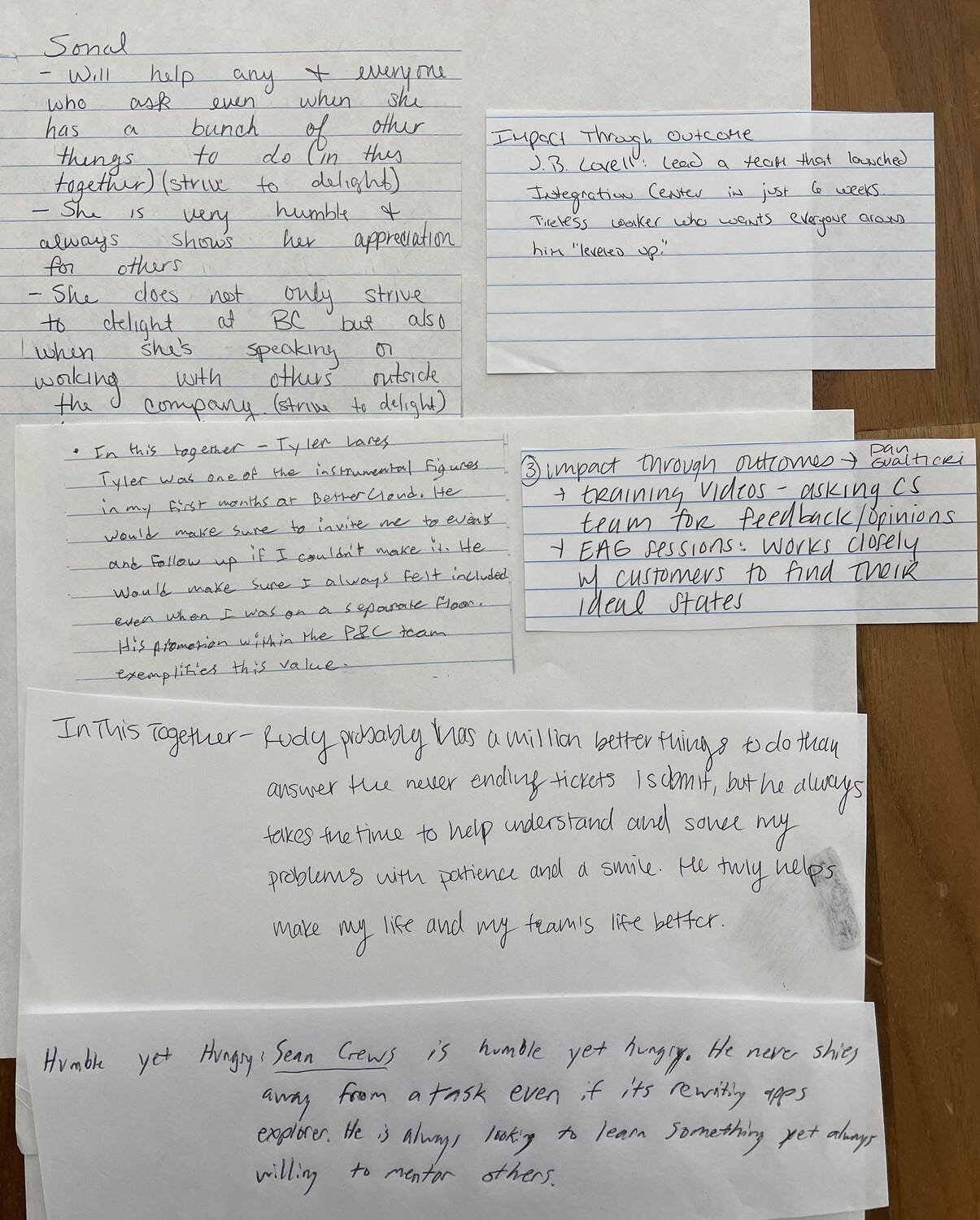
After showing the video at kickoff, we asked everyone to take five minutes to write down which value resonated the most with them and share a story of how they’ve seen someone at the company exemplify that value.
We then put people in breakout groups to share those stories with each other. Here are just a handful of hundreds of stories we collected.
Stories we collected about employees who lived our values
We held everyone accountable.
We included questions about our values as a standard part of everyone’s performance review.
Managers and peers didn’t just rate another employee’s skills or sales numbers. They were asked to identify the values that others most live up to and give real-world examples.
In the interest of keeping everyone honest, they were also asked to identify which values an employee might need to work on incorporating–again, always giving clear context.
We screened for values. The third step of our interview process with new candidates became a values interview.
A rotating pool of BetterClouders were asked to serve as values interviewers. They assessed whether candidates had the capacity and willingness to live up to our values.
This was as important as any other step in the process, and we asked the interviewers to treat this as a gatekeeping assignment.
I knew this effort had been successful when people throughout the company began to naturally reference our values. I knew they were making a difference when we started rejecting otherwise qualified candidates because they did not represent our values. One of my proudest moments as CEO was when we conducted our annual employee survey, and 96% of the company could list our four values from memory.
Celebrating Values Well-Lived
Rewarding employees is an incredible boon to company morale. And while it’s helpful to praise employees for performance, it’s more important for your people to see management recognizing your values. It sets the right tone and goals for everyone — from junior employees to new hires — who quickly find great examples to emulate.
Here’s how we went about acknowledging values-driven team members:
Crowdsourcing positivity. One of the most impactful things we did was to create a #shoutouts channel in Slack.
Anyone at BetterCloud could easily give a shoutout to anyone else, which was immediately visible to everyone in the company.
The person giving the shoutout only had to identify which of the four values the shoutout aligned to and include a detailed description of what the recipient did to earn the recognition.
This became our most popular Slack channel.
Public accolades by leadership. I know I said that values should extend beyond all-hands meetings, but it’s important to call them out there too.
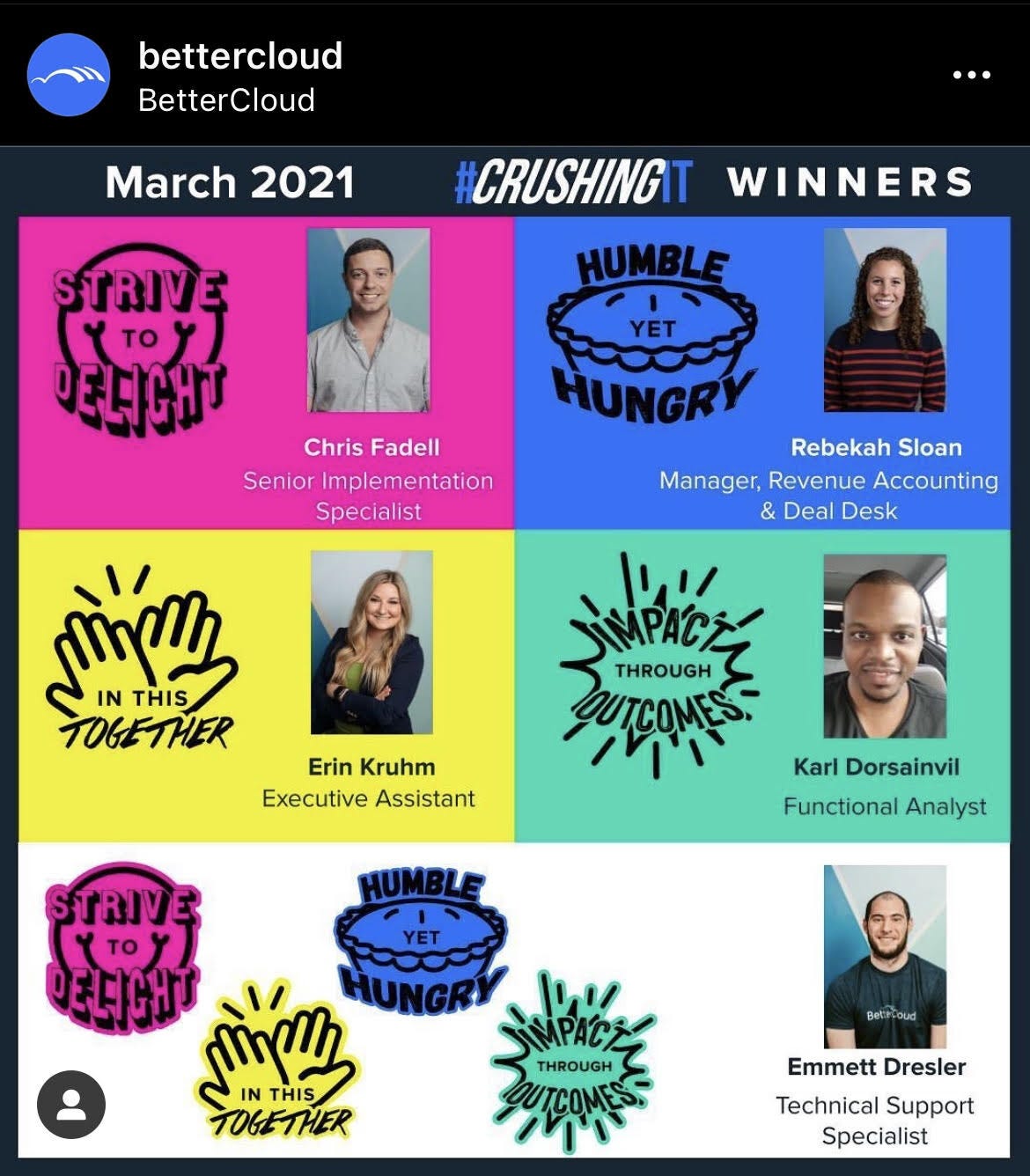
Every month, we honored five people with the “Crushing It” award.
Our People team identified the five people who had been mentioned the most on Slack and had the most meaningful stories attached to their shoutouts. We reviewed and discussed this list at ELT meetings before making the final decision on who would be recognized.
This ensured a lot of visibility for the people who exemplified our values. It also gave ELT members a chance to discuss what their own interactions and experiences with them had been like.
Here is an example of what we posted to our social channels after recognizing the “Crushing It” winners:
Create aspiration. We created the annual BetterClouder Awards.
This was the highest form of recognition at the company—only 5% of the company received it.
Given out annually at our company kickoff, these awards were based on shoutouts, performance reviews from the previous year, and a special nomination form.
Values are Your North Star
Values, and the process of creating them, will look a bit different from company to company, so sharing insights can be tremendously helpful. How have you and your company navigated this process, and what was the impact values have had on you? Feel free to send me a message or comment with your thoughts!
Here’s what some other CEOs say about defining company values, and the outsized impact it has had on their company.
Nick Mehta, Founder and CEO of Gainsight, believes values must be personal to the founder to be authentic. He reinforces Gainsight’s five values—like Golden Rule and Shoshin—through onboarding, weekly emails, and 360 surveys of senior leadership. These values are embedded in hiring and presentations to maintain alignment company-wide.
Itamar Friedman, Co-Founder and CEO of Qodo, sees culture as a CEO’s top priority and shaped Qodo’s early around core values and hiring principles. He stresses that culture must evolve with the company’s mission and ICP. Friedman warns against copying past cultures, even with the same founders, as each venture needs a unique foundation relevant to its customers and context.
Jindou Lee, Founder and CEO of HappyCo, developed the company’s core values in response to prior negative work experiences and a desire to lead with integrity. Around year three, he and his co-founder used the “Mission to Mars” exercise to select 10 employees whose behaviors they most wanted to replicate, then identified five core values based on shared traits already present in those individuals. Lee emphasizes that values should be grounded in real behaviors worth preserving and replicating, not idealized concepts.
Ryan Simonetti, Co-Founder and CEO of Convene, formalized the company’s core values—genuine, relentless, integrity, teamwork (GRIT)—early in its growth and has remained committed to them for over a decade. He integrates these values into every aspect of the business, including an interview process that scores candidates on "grit." Simonetti emphasizes that while mission and vision evolve, core values must remain constant to guide behavior and decision-making, particularly in high-growth startups.
Alex Theuma, Founder and CEO of SaaStock, formalized company values several years in, with curiosity being a key trait he seeks in hires. He evaluates candidates on how they demonstrate curiosity and reviews employee alignment with values during performance evaluations. Adherence to values is a factor in determining long-term fit at the company.
John Fazzolari, Co-founder and Co-CEO of Revivn, helped codify the company’s culture into The Revivn Way, a guide linking values to real stories and practices. A key value, the “Rigatoni Rule,” reflects their focus on deep, personal customer relationships through what they call “unreasonable hospitality.” Fazzolari says this approach builds trust essential to handling global IT asset disposition.
After nearly 20 years of operating, advising and investing, I will tell you that company values are your north star, not a distraction.
Authentic, memorable, lived and celebrated company values are the greatest driver of organizational performance and health. Embrace the challenge, be thoughtful and be determined. Good luck – and shoot me a note if you run into any issues, or you have questions!
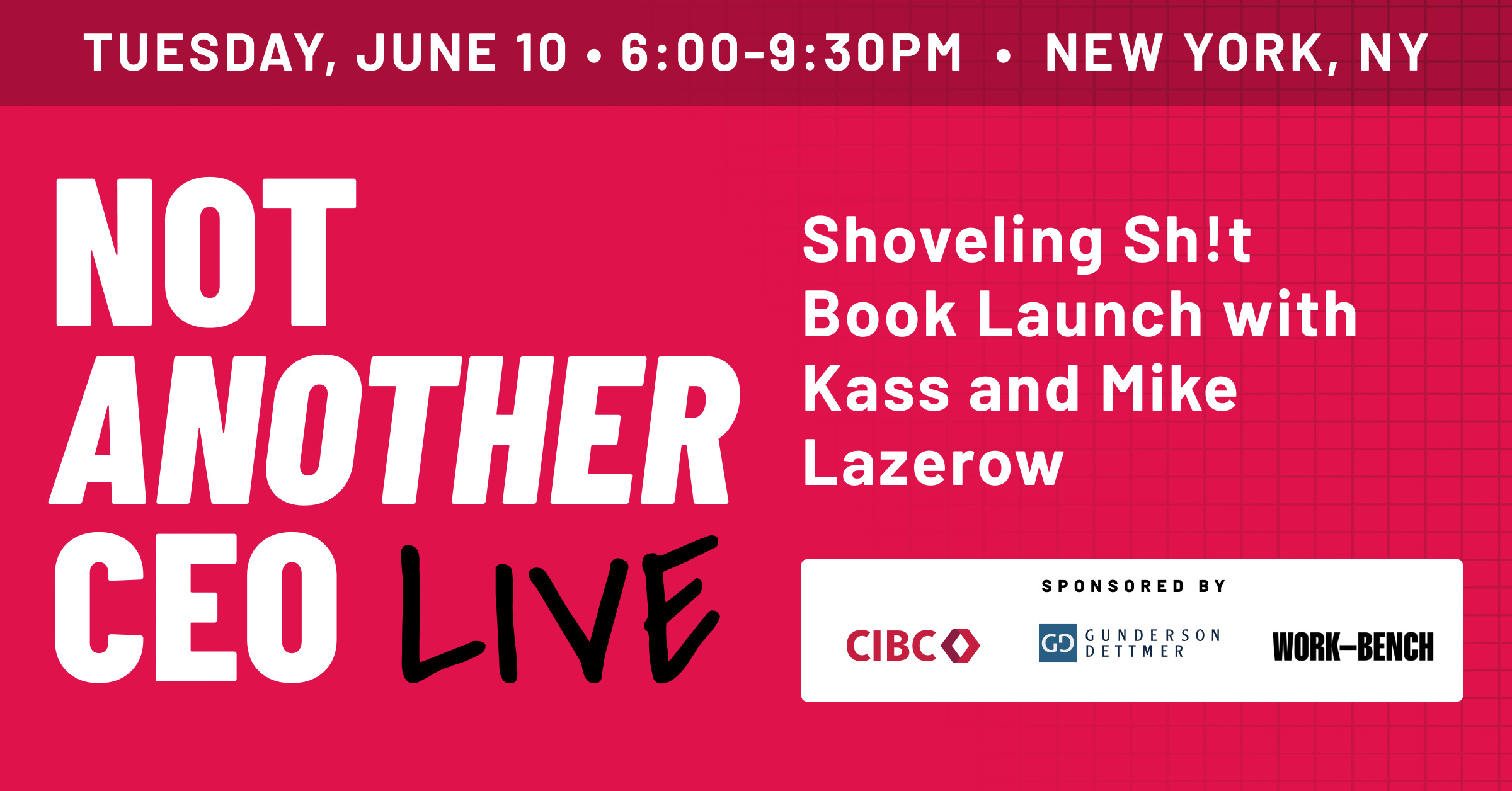
Our Co-Founder David Politis will interview Kass and Mike — Co-Founders of Buddy Media, sold to Salesforce for $750M — about the chaos, beauty and heartbreak of building startups. Join 100+ venture backed founders, CEOs and executives, and participate in live Q&A with three NYC tech OGs.
Thanks for this -- great discussion of a topic lots of CEOs don't put enough effort into. It's such a wasted opportunity when a company creates generic values like "Respect" or "Integrity," and then they go in a drawer somewhere to be revisited, maybe, at an offsite a few years down the road.
The way your employees talk about the BetterCloud values makes it clear they understand them, care about them, and apply them.



Thanks for this -- great discussion of a topic lots of CEOs don't put enough effort into. It's such a wasted opportunity when a company creates generic values like "Respect" or "Integrity," and then they go in a drawer somewhere to be revisited, maybe, at an offsite a few years down the road.
The way your employees talk about the BetterCloud values makes it clear they understand them, care about them, and apply them.
Authentic, memorable , lived , celebrated- simple, straightforward and honest four attributes!