


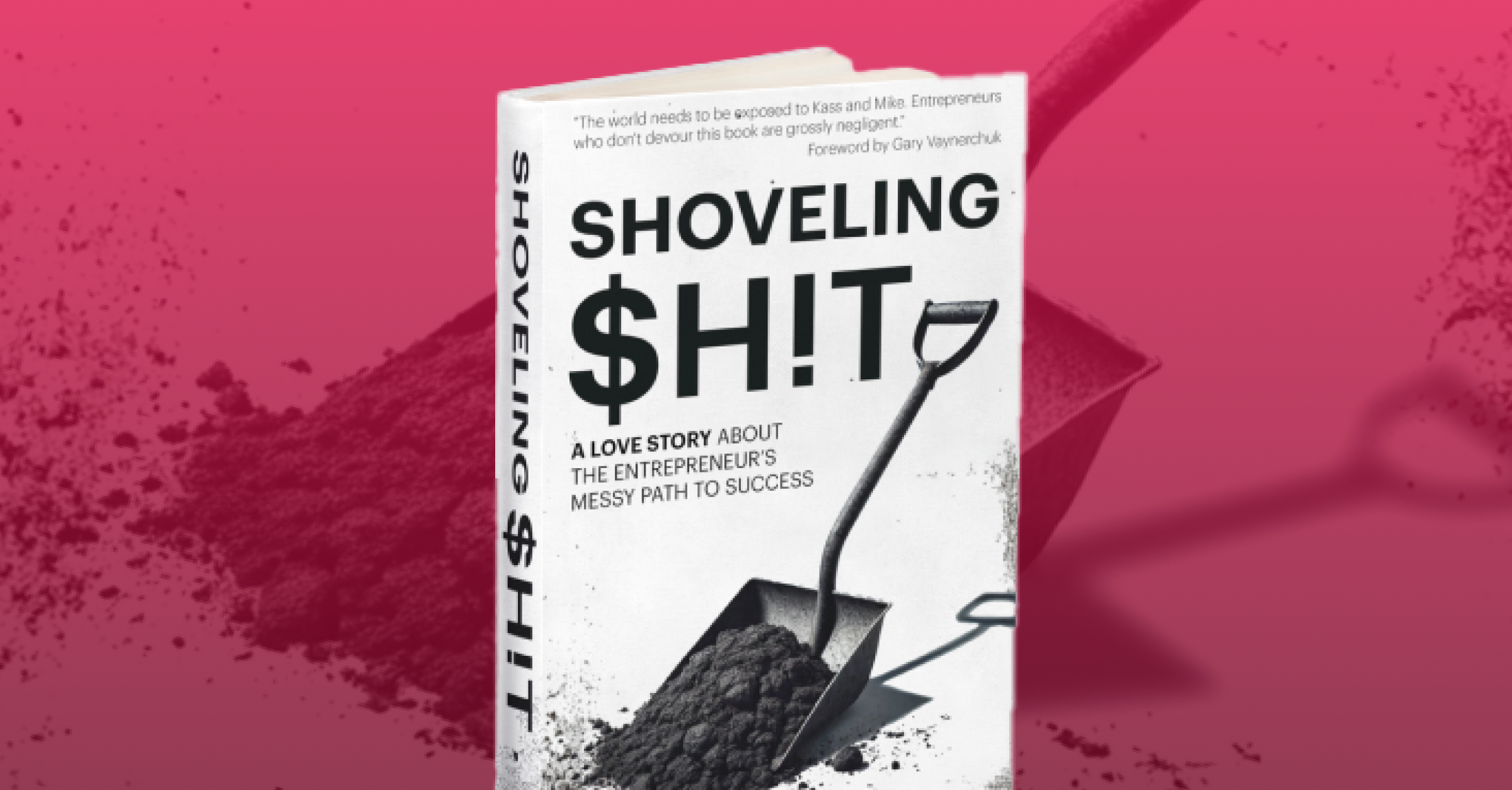
We are thrilled to publish the below excerpt from the brand new book Shoveling $H!T: A Love Story About The Entrepreneur’s Messy Path to Success, by Kass and Mike Lazerow. Today’s excerpt is written from the perspective of Mike.
Kass and Mike Lazerow are serial entrepreneurs and investors best known as the cofounders of Golf.com and Buddy Media, the leading social media marketing platform that sold to Salesforce for $745 million.
After our daughter Vivi’s birth in May 2007, we focused on two primary objectives: keeping our baby alive while caring for Myles and Cole (5 and 3, respectively), and finalizing the plan to birth Buddy Media.
Every inch of our two-bedroom apartment in New York City’s Upper West Side was filled with the supplies to sustain our family zoo. We worked mainly in our bedroom, which we don’t recommend to any cofounders, and at a small table in the front living room.
It wasn’t the most relaxing time for us, but between day camp drop-offs, dog walks, and baby feedings, we were ready. Only one obstacle stood in the way of making the dream a reality: we needed money—a lot of money.
Facebook’s move to open its developer platform to third-party applications represented a fundamental shift in the internet, moving it from a single-player experience to a social one. We wanted to be a part of it and move fast.
We needed about $1.5 million for the first year to get an office and hire a team of engineers to build out the apps. With three kids and having just purchased our first apartment in New York City, we had plowed through what we’d earned from selling Golf.com, so now we were cash-poor.
Our first call to raise the money was to Howard Lindzon, one of the best early-stage investors we know. We hadn’t known each other very long but trusted his instincts and advice. Howard has a great feel for markets, opportunities, and young founders, and was the first investor in several successful companies—Rent.com, Robinhood, eToro, Lifelock, and Manscaped.
I (Mike) told Howard about our newest venture, and he loved our plan and committed on the spot. While his $50,000 would be a small part of Buddy Media’s seed round, we were off and running.
The momentum from his commitment and introductions to other investors proved invaluable and helped us close $1.5 million in September from a great group of angel investors.
We announced the company’s launch on September 23, 2007. The initial plan (and a subsequent plan after that!) did not work, so we successfully pivoted to a software-as-a-service (SaaS) model about eighteen months later.
However, we never would have gotten there if we hadn’t kept one key priority at the top of our list: feeding the baby.
Business 101: Stay in Business
There’s only one way a company goes out of business: it runs out of money. Money is to businesses what food is to babies. No food, no toddler.
We tell founders that the first three jobs of an entrepreneur are:
Don’t run out of money.
Don’t run out of money.
Don’t run out of money.
Life as an entrepreneur is easier if you assume your business will take twice as long AND twice as much money to do anything that matters.
Many businesses are profitable from day one. Accountants, lawyers, consultants, and other service businesses, where the entrepreneur is the product, can earn immediate revenue. If you are building a product (manufacturing, software, etc.) or selling others’ products (retail store, e-commerce), you most likely will need to raise money. So embrace the crap that is fundraising because that’s how you feed the baby.
We understand the fear that comes with asking people you know for money. We didn’t like doing it. In the best of circumstances, asking someone for thousands (or millions) of dollars can feel awkward, especially if you are new to it and haven’t developed sales and fundraising skills.
Don’t ask for money. Offer investors an opportunity.
Like most things, raising money gets easier the more you do it. As first-time entrepreneurs with U-Wire and Golf.com, we had no track record, and our network of potential investors was small. The more success we had, the more we learned, and the larger and more robust our network grew, the easier it got to raise the next round. Eventually, potential investors came to us.
Looking for Pots of Gold
Most of the businesses we have started and invested in needed more money than personal savings or initial revenues would provide. So, we had to look to other sources like angel investors, venture capital firms, and strategic investors. But there are also other sources — lending institutions (like banks) or government and nonprofit grants, for instance.
If you find yourself with a high-risk, innovation-based company or lack the assets to secure the debt, you will most likely have to give something up to get the amount of money that feeds your baby’s growth. That something is ownership (equity) and a bit of your independence.
Friends, colleagues, and family members typically are your first source of equity capital, especially if you are a first-time entrepreneur. Even Jeff Bezos turned to his family for his initial capital.
While VCs provide money and strategic advice, they are far more involved in the business than other partners. Not only do you give up ownership and independence, but you risk ending up with unfavorable terms and losing control to your new partners.
Strategic partnerships are a form of equity funding that we believe you should only consider later in your business’s lifecycle. This is when key players like distribution partners buy a stake in your company in exchange for a greater or exclusive role.
Done well, strategic partnerships can provide money and improve efficiencies, but locking arms with a partner might also dilute your brand or prevent you from working with other potential partners in a competitive marketplace.
One of our last financing rounds for Buddy Media raised about $50 million by working with strategic partners. Since we had shifted to our software-as-a-service model, we weren’t just selling to large brands but also to their advertising agencies, and WPP, a holding group that owns some of the largest agencies in the world, was one of those agencies. This streamlined and accelerated our work with their 140,000 employees and hundreds of agencies.
We formed a similar strategic partnership with Publicis Groupe. If we were raising capital from a strategic partner, it was important that we had two so we didn’t become known as either the WPP company or the Publicis company.
Picking your Partners
No matter who you work with—VCs, friends, family, or even lenders and grant providers—picking your partners should be a deliberate process. You want to ensure a fit which gives you the confidence to navigate the tough times together and share the fruits of your labor. All investors are friendly during the good times. You need partners who will also be there for you in the tough times.
The best way to pick your investors is to find ones who share your values, understand your vision and timeline, offer mutually beneficial terms, and, if you are lucky, provide tangible value to the business you are building.
Your cousin might invest $10,000 and then have almost no involvement in the business other than reading the reports you send. But professional investors like venture capitalists want to get involved and stay apprised of the latest developments. These must be voices you trust (that’s where the relationship comes in) and who can work for the money they’ve invested by providing their skills and expertise. Some investors have name recognition that adds credibility to your startup. Others might have expertise in areas such as finance or fundraising.
Picking the right partners is pretty straightforward when working with individual investors, like friends and family. It’s mainly a matter of clear and upfront overcommunication that there is no pressure to invest; they should only invest capital they are willing to lose and expect this investment to be illiquid for many, many years.
Venture capitalists bring a different perspective because investments are their livelihood and they represent other stakeholders. Regardless of how nice they are to you at the start of the relationship, never forget that they negotiate deals for a living. You don’t. They have many companies in their portfolio. You have just one, and you’re all in. They know the ins and outs of term sheets and the dynamics of founder negotiations. You most likely don’t, unless you have raised multiple rounds.
Our advice when considering venture capital partners, first and foremost, is to avoid shotgun marriages.
VC firms that see your company as pregnant with potential often will try to get a ring on your finger before you consider marrying someone else, even if they might ultimately leave you alone at the altar. They will try to lock you into a commitment when exploring your dating options is in your best interest.
During one fundraising round for Buddy Media, several VC firms wanted us to sign a term sheet early on that would lock us into an exclusive negotiation period while they did their due diligence and figured out if they really wanted to do the deal.
We prefer clean financing rounds where all interests are aligned. We have avoided complicated terms for the most part and urge you to do the same if you can. Watch out for terms like participating preferred, harsh ratchets, unusual blocking rights, forced dividends, 2X+ liquidation preferences, guaranteed returns, and set exit dates.
One firm we were interested in asked if we would consider “a participating security with a low threshold for kick-out (2.5x maybe)?” A kick-out? What does that even mean? Thankfully, we had our own VC ace, Roger Ehrenberg, who helped explain the antifounder verbiage and steered us to more friendly terms.
If given the preference, we would take a lower valuation for simple, clean terms that align everyone’s interests around the table. Investors prefer complicated protections to increase their returns and protect them from downside scenarios.
We are often asked about valuation. Specifically, how do you value a young company? The answer is simple: the price of anything is the price someone is willing to pay for it. It’s no different than real estate. You may think your house is worth $1 million, but if you only have one offer for $400,000 after a year on the market, then the value of your house in the current market is $400,000.
Many firms complained about Buddy Media’s high valuation during each of our fundraises, but we had very little say in it. Markets are efficient and speak for themselves. We had multiple interested parties for each round. The company was in a new white-hot space (social media) and we were posting massive growth. Complaining about our valuation was like complaining about the weather. It was what it was.
Always Return Emails
There’s really only one time when founders need to think about raising money for their business: right now. You always need to have your mind in fundraising mode.
Most of the time, however, you aren’t raising money, you are growing your network of potential investors by building genuine relationships. The best way to build genuine relationships is to show you care for people regardless of whether they can give you anything in return.
Howard Lindzon, who we mentioned earlier as the first outside investor in Buddy Media, vividly illustrated this point. Ironically, I (Mike) didn’t immediately put this principle into practice with him, but it paid huge dividends for us once I woke up.
Shortly after Kass and I sold Golf.com in 2006, Howard invested in GolfNow.com, a company that developed technology for managing online tee times. We didn’t know Howard, but he knew about our company, so he reached out for advice. Meeting with him would have been an amazing opportunity for me, but we had young kids, I was consulting, and life was a blur.
I pretty much ignored him. But persist he did, and after several emails and calls, I eventually agreed to meet with him. Our relationship quickly took off.
I told him what I would do about growing an internet business in the golf industry and made introductions that helped him sell GolfNow.com to Comcast, but I never had any quid pro quo in mind. He was just a new friend who needed help I could give, so I was giving it. And he owed me nothing a year later when we met at Stone Rose in the summer of 2007. But he provided far more than his $50,000 investment in Buddy Media.
Howard introduced me to Mark Pincus, the founder and CEO of Zynga, who was building on the Facebook platform. Mark and I met over smoothies one day and he loved our idea. He then introduced me to Peter Thiel, an early investor in Facebook who was on Facebook’s board. Peter also liked what we were planning, and, as you might expect, having a Facebook board member on our side proved extremely helpful in building a business on Facebook’s platform.
After Mark and Peter committed to investing in our company, I sent Howard a thank-you note on July 3, 2007. His response (from his Verizon Blackberry): “Always return emails :)”
Lesson learned.
Throughout the company’s history, we raised about $100 million, much coming directly or indirectly from relationships we developed long before it was time to raise money. I met Jules Matz, for instance, when he was a student at Stanford; in 2010, we raised a $20M Series C financing round after he joined IVP to supercharge our growth.
We raised money from our friends at Insight Partners (led by Deven Parekh) and GGV Capital (led by Glenn Solomon and Jeff Richards) for our series D financing. By the time each of them invested, they knew the company because we had built relationships even when we didn’t need money.
How did we do this? We kept them in the loop. We would send them quarterly updates on our business—our big hires, our new customers, and the events we were hosting. And we’d learn about their interests and look for ways we could add value to their world. We wanted them to view our company like a nightclub with a long line of people trying to get in—even if you don’t know what’s happening inside, you figure it’s something interesting and worthwhile. If we liked each other, they would jump to the front of the line when opportunities arose to work together, and we could negotiate with a relational foundation, not just from a transactional perspective.
When you are raising money, it’s important to focus on the things you can control, like the way you treat people, the investors you will work with, the terms that benefit your business, and how you will use the money.
After all, raising money isn’t an end in and of itself. It’s a means to an end. It’s how you feed your baby so it can grow strong and healthy. And putting food on the table is just the beginning. Once you do that, you have something ready to crawl, walk, and run, run, run. Now the real work begins.
You can continue with Mike’s story of feeding the baby by reading Shoveling $H!T. The book is available for purchase on Amazon.
Mike Lazerow is a serial entrepreneur and investor best known as the cofounder of Golf.com and Buddy Media. After selling Golf.com to Time Warner in 2006, Mike cofounded Buddy Media, the leading social media marketing platform that sold to Salesforce in 2012 for $745 million. Since then, he has focused on providing capital and advice to the world’s most innovative founders.
Mike has supported close to 100 early-stage startup founders. He has served as angel investors and advisors to Scopely, which sold to Savvy Games for $5 billion in 2022, and Liquid Death, the canned water company whose “evil mission” is to make people laugh and get more of them to drink healthy beverages more often, all while helping to kill plastic pollution.
Mike lives in New York City and the Hudson Valley with his wife (Kass) and three children (Myles, Cole, and Vivian) and two rescue dogs (Cece and Gizmo).

Love this excerpt! Can't get enough personal stories about entrepreneurs. Thanks for this. Purchasing the book.