



You know what sucks as a founder or CEO? Seeing a new competitor pop up that’s blatantly copying everything you do. Your product, your messaging, your API docs. Everything. And then they undercut you on price by 50%.
I’m not talking about your typical competition. I’m talking about literal copycats. They identify the leader in a space, copy and paste blog posts, and forget to remove the original company’s name. They build and name their features the same way and copy the user experience screen for screen. They use the same obscure mock user names in API docs.
You may think this sounds ridiculous, but it’s happening more and more.
I’ve been in software for over two decades, and I’ve watched the barriers to entry collapse. What used to take months of planning, hundreds of thousands in infrastructure, and a team of engineers, can now be done in a weekend. Someone recently built a DocuSign clone in two days using Cursor.
Two days.
Here’s another one that just popped up in my LinkedIn feed:
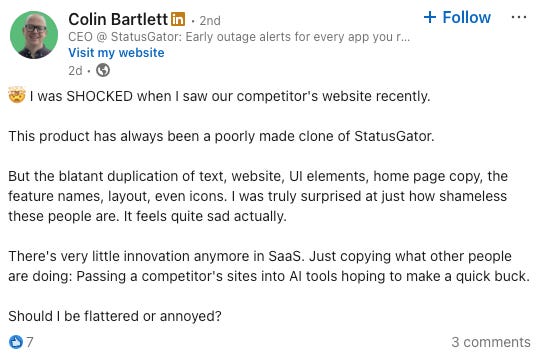
I read something recently from Jamin Ball that stuck with me: “I’ve come to believe the idea of a long-term moat is mostly a myth, especially in this market. Moats aren’t permanent. They’re time-bound. At best, they function as a bridge. And companies either use that bridge to reach the next defensible position, or watch their moat get breached.”
He’s right. But while no moat lasts forever, some take years to build. And in a world where anyone can clone your product and copy your messaging, the ones that take the time to build something sustainable are the ones that matter.
I will start with how we got here, and then I’ll share the six things I’ve seen work to create real distance between you and the inevitable copycats.
Table of contents
How we got here
6 strategies to set yourself apart from the competition
The foundation that makes it possible
Today’s moat is built on a foundation of trust
What other CEOs say
How we got here
21 years ago, when I started my career, starting a software company required real physical infrastructure.
At Vocalocity, we had to rent space in a data center and put servers in racks at that facility. Then you had to manage those servers, upgrade the software on them, upgrade the servers themselves, and make sure there was enough storage. I remember we had wiring diagrams to make sure the racks were done correctly.
This was the reality of starting a software company until the cloud era.
Then came companies like Rackspace, the cloud before the cloud. Then AWS, Google Cloud Platform, and Microsoft Azure. Suddenly, you could stand up servers anywhere in the world instantaneously. You could scale up or down based on usage. But you still had to raise tens of millions of dollars and hire large teams of engineers to build your systems.
Today, you can go to Cursor, Replit, Lovable, and literally tell it to copy an existing product. The guy who cloned DocuSign just told the AI what he wanted, and it built it. He stood up a competitor for a fraction of the cost and in a fraction of the time.
But it’s not just the software that’s easy to copy with AI. It’s everything. Your entire website. Your messaging. Your design. Your content.
Pair all of this with VC funding being more accessible than ever, powerful global distribution channels like social media, and ready-to-go payment infrastructures like Stripe. Everything you need to create, sell, market, and fund a company is more accessible than ever before.
The result? Oversaturated markets full of copycats. The thing that used to be the hardest (building the actual product) has become the easiest. Differentiation is the real challenge.
So, what are the hard things you can do to actually stand out? What sets you apart when ten companies can build the same thing in a week?
6 strategies to set yourself apart from the competition
These aren’t quick wins or growth hacks you can implement overnight. They’re the hard things that take time, money, energy, and real commitment. But that’s exactly why they work, because your competitors can’t just copy and paste them. The strategies below are ways you can set yourself apart and they’re all centered around one thing: building trust.
1. Community building
Real community can’t be bought or copied in two days. I’m talking about the kind of community where people want to be your customer just as much for the community as they do for the product itself.
Companies like Gainsight, Marketo, Clay, and JAMF have built this. Nick Mehta at Gainsight has become synonymous with customer success because he’s spent years, day after day, advocating for customer success leaders. He’s largely responsible for creating the role of “customer success”. They host a conference every year and ultimately created a place where everyone in the customer success space felt they needed to be. And JAMF created the world’s largest Slack community for Mac admins.
The key is making these communities (whether a digital Slack community, a local meetup, or an annual conference) all about the job function or unique problem a group of people faces. Gainsight’s conference is all about customer success, not Gainsight.
The copycats can’t replicate this because a real community requires proving yourself year over year. You can’t just vibe code an app and get 10,000 people to join your Slack community. It’s about creating a place for real connections, and it has to come from authenticity.
2. Thought leadership
If I’m buying a product, I want to feel like I’m buying it from someone who sees the future of the space they’re in. Someone who’s an expert and has felt the pain. Someone who knows the problem better than I do and can help me get better at my job.
You can’t just show up one day and become a thought leader. You have to build credibility over time. And in a world where AI can generate content in seconds and everyone is just copying each other, real thought leadership is about taking the time to create something unique and helpful.
At BetterCloud, we put out a State of SaaS report every year for over a decade. It required collecting information from thousands of people, identifying the right questions to ask, and putting it all together in a consumable way. AI isn’t going to do that for you. I also wrote two books for IT leaders and we had a podcast featuring forward-thinking folks in the space.
It’s not that these things sold millions or had millions of subscribers. That’s not the point; the point is, the people who got value from these things are the exact people we wanted as customers.
Reputation and credibility take time to build. It’s not something someone can easily copy or pay to accelerate.
3. Raving reviews and word of mouth
There could be ten products in your space that are literally the same thing on the surface. But as a buyer, how do I know what’s real and what’s a knockoff?
Third-party validation and social proof is how buyers know what’s quality and what will solve their problems. It’s customers who have used your product, saying it delivered the value it promised and it made a real difference to their company.
This shows up as customer reviews, case studies, and word of mouth. And you can’t shortcut those. Customers have to buy the product, use it, see results, and then you have to ask them for validation. That’s not something a copycat can fake in a couple of weeks.
One of the most impactful things I’ve seen is getting happy customers in the same room as prospects. This real-time interaction gets potential customers excited about your brand when they see energy in the room.
Bring a camera crew to your customer summit and record customer testimonials. Have your customer success team send a link to submit G2 reviews once they have validated that the customer is getting real value. Create a digital “wall of love” that consolidates all positive messages, reviews, and praise from your customers so prospects can see them. And showcase customer stories front and center on your website.
Positive word of mouth takes time to build, and copycat competitors can’t replicate that right out of the gate.
4. Partner networks
A partner network multiplies your reach in ways you can’t replicate by hiring.
At BetterCloud, I could only hire 20 salespeople because that was the budget. But if we worked with 20 partners, and each of those partners had 30 salespeople, we just expanded our network from 20 to 620. Imagine how many more people 600 people can talk to every day.
And those partners already have relationships with their customers. They’ve taken the time to build trust and community and thought leadership. Now you’re leveraging their trust that’s already there. You’re leveraging their distribution network.
Look at companies like Salesforce, ServiceNow, Workday, and Atlassian. Are they the best products? I don’t think so. But can anyone displace them quickly? No. Why? They’re protected by multiple layers of partners who are motivated to protect them because they’re profiting off the relationship. Microsoft says that for every dollar of ARR on their platform, partners make $10. What are those partners going to do to protect their $10? They’re going to defend Microsoft.
Partners come in different forms. There are enterprise partners like the Salesforce ecosystem or Atlassian marketplace, and distribution partners like Google Workspace working with domain registrars. When you buy a domain from GoDaddy, it asks if you want a Google Workspace account. With a good partner network, you’re not just creating distribution, you’re boxing out competitors.
5. Customer experience
Whether you’re buying something in the drive-thru at McDonald’s, changing your flight on Delta, or implementing the most complex, mission-critical platform at the core of your company, human beings recognize a good customer experience.
AI can handle a lot. Maybe 75% of frontline support questions. But what about the other 25%? When I call Delta and I’m stressed out trying to rebook my flight, speaking to a human being who can navigate me through that experience matters.
This is especially true for mission-critical software. BillTrust’s CEO Flint Lane personally called every one of his top 100 customers during a malware attack. At the time, Billtrust processed billions of dollars in payments each year.
That’s customer experience. It’s built on trust. And the copycats can’t easily copy it because it’s expensive and takes time.
Sure, using AI to solve routine requests can help a company cut costs. These savings on Customer Experience are one of the reasons a copycat can undercut you on price. But when someone buys a product for tens or hundreds of thousands of dollars, how you support them when things go wrong matters.
6. Creative growth hacking and personalized outreach
Standing out from the crowd is hard. Everyone has access to the same tools and distribution channels. So what sets you apart is the creative, hard-to-scale GTM motions that require personalization, creativity, and effort.
I recently heard about a company that conducts deep research on a prospect, creates a custom whitepaper for them, and then puts it into NotebookLM to generate a podcast. They send the 10-minute podcast with the attached white paper to the prospect. It took a ton of time, but it worked.
I’ve worked with companies that sent their sales team to people’s offices with swag bags and handwritten notes. One salesperson who would buy golf trading cards and send them with handwritten letters to prospects. He’d write something like, “You remind me of Tiger Woods because of these things you did in your career, card enclosed.” His response rate was around 80%.
Once, someone cut out an article from the New York Times in which I was featured, framed it, and sent it to my office with a handwritten note explaining why the article resonated with him. How could I not respond to that?
These things build trust because they require time and real human effort. And while it’s possible to copy them, most companies won’t put in the work.
The foundation that makes it possible
None of these strategies work without a mission-driven team that actually cares.
You can’t build an authentic community with contractors who clock out at 5 pm. You can’t deliver exceptional customer experience with people who don’t care about the outcome. And you can’t create real thought leadership when your team is just going through the motions.
Building a company is difficult, no matter what technology exists. Going from zero to something is really hard. So is going from something to scale. It comes down to the people.
Choose the right people, motivate them, and give them a mission and values they actually want to live by. Show them the impact of their work, have them see how it’s helping customers, and make sure the customer is front and center.
If you do that, your team will go above and beyond because they care, not because they’re paid to. That’s what makes the difference and enables the above six strategies to happen.
Today’s moat is built on a foundation of trust
When all of this is done together in unison, it becomes part of your brand’s unique DNA, and it’s all centered around trust. It’s how people experience your company, how they talk about you, and what they associate you with.
When you do these things, it’s clear you’re not fly-by-night: you can actually hold the line on your price, build long-term relationships with your customers, and they will buy over and over again. But building that trust takes an incredible amount of work, care, and investment of time, money, and energy.
As Flint Lane said, a company is like a castle. But it’s more than just the castle that protects you. There are drawbridges, there are arrows, and there are multiple layers of protection. All these things together give you trust that your family will be safe when the inevitable enemies attack.
In the end, trust is the competitive moat around your fortress, and that’s how you win in an oversaturated market.
What other CEOs say
Second-Mover Advantage
Max Junestrand, Co-founder and CEO of Legora, describes a strategy of competing with larger, better-funded rivals by capitalizing on second-mover advantages and disciplined product decisions. He highlights avoiding costly missteps, enabling faster iteration and better performance. Legora now competes head-to-head in major deals and is seeing exponential growth.
Mission as Moat
Ryan Wang, Co-founder and CEO of Assembled, focused on integrating AI with human support to differentiate themselves in a crowded field of support automation startups. He emphasizes that Assembled’s mission — helping companies scale high-quality customer support — resonates with both users and customers, offering a holistic approach combining AI and human empathy. This alignment of mission, product, data, and customer insight forms a compound moat.
Customer-First Product Vision
Phil Fernandez, Co-Founder & CEO of Marketo, describes a customer-first strategy that deliberately ignored competitors. He led product development without ever reviewing rival offerings, instead focusing entirely on solving customer problems and gathering feedback directly from users. Sales reps were trained to avoid competitive comparisons and instead reference satisfied customers to illustrate value.
Outlast, Not Outspend
Kyle Porter, Founder and former CEO of Salesloft, executed a competitive strategy focused on endurance, customer focus, and cultural values rather than feature battles. Despite facing better-funded rivals, Salesloft outlasted competitors and won through execution, innovation, and organizational health. Porter underscores the importance of deeply understanding and serving customers.
Customer-First Positioning
Ryan Westwood, Chairman and CEO of Fullcast, explains that their competitive edge lies in prioritizing RevOps leaders over sales leaders or reps, distinguishing their platform from legacy tools. He saw opportunity in disrupting incumbents ripe for replacement. Fullcast aims to scale by offering lightweight SaaS validated by market size and clear differentiation.
Speed and Autonomy Over Scale
Craig Walker, Founder and CEO of Dialpad, explains that he left Google to build a communications platform independently due to the speed and autonomy startups offer. He highlights the agility of a startups compared to larger, slow moving organizations where internal priorities often shift.
This is spot-on. AI features are getting copied fast, so the product alone is becoming commoditized. The defensibility shifts to what doesn’t copy easily:
- Trust + workflow adoption: teams rely on it daily, with clear guardrails and accountability.
- Embedded in systems of record: deep integration into tools like Salesforce/Jira/Workday makes switching painful.
- Compounding decision/outcome history: the system captures what worked, what didn’t, and why.
- A real feedback loop: human review + outcome metrics → updates to prompts/policies/routing (and sometimes fine-tuning). Copycats can copy the interface, but they don’t get the compounding advantage from real customer feedback.
Out of your 6 strategies, which one do you think is most underrated right now?”