



Every pivotal moment we had at BetterCloud could be tied back to me personally spending time with customers.
Here is the one I think about the most: I came up with the idea for BetterCloud’s multi-SaaS platform — our big pivot — when I shadowed an IT director and watched him work for an entire afternoon.
I wanted to see firsthand what his challenges were and where the friction was. I’d never seen so many Chrome tabs open in my life. It was crazy how much they had to click back and forth, copying and pasting, refreshing just to do a seemingly simple task of offboarding an employee from their SaaS applications.
At that moment, I realized there was a very real problem for IT, and I understood how we could solve it.
What’s unique about this story? It didn’t happen at inception. It happened when we were a Series B company with hundreds of employees, thousands of customers and almost $10M in ARR.
Similarly, our best product marketing ever came from my follow-up to a survey asking customers which of three messages resonated the most. A big decision about how to support our customers in the early days of COVID came from a virtual meeting I held with a small group of trusted clients on that topic.
Every founder/CEO knows that customers are the lifeblood of the company. In the early days, most of a founder’s time should be spent directly interacting with them. But as your company grows and more demands are placed on you, that direct exposure to customers diminishes. Often, those relationships shift from direct to indirect as you build a team and task them with understanding and making customers successful.
As a CEO, many things will try to pull your personal time and attention away from customers. It is critical you resist this. Don’t forget your #1 job is to always be the advocate for the customer, and serve as its voice — from your first day to the last.
Your Personal Attention Matters
Spending quality time with customers can be daunting, and difficult to prioritize, but even a little effort goes a long way. Everyone wants help making their lives faster, easier, and better. If they believe you can help, they’ll be eager to share their challenges.
The more that you take personal interest in this as CEO, and actually listen and take action on what customers say, the more people will trust you and your business. It is a truly unique thing for a CEO to take a deep personal interest in their customers — even though it shouldn’t be.
So do not underestimate the loyalty of customers who believe they have influence over you and where you will take the company. You will create loyal customers for life, who will evangelize and bring your product to every company they ever work at.
There are many ways to gather customer feedback, and engage, but the key is that the CEO should always be leading the effort. You need to collect and consume this information directly, not through others.
1:Many Feedback
At BetterCloud, we collected broad based feedback in many ways including:
Prompting customers to provide feedback on every support ticket.
Running annual surveys across our customer base.
Holding live webinars, where we would ask customers to provide input via chat and poll features
Organizing an annual in person conference, where we would do a roundtable session with 7-10 customers at each table. (A BetterCloud employee would moderate each table while I oversaw the entire session, providing conversation prompts and soliciting folks to share responses).
There are many more options to choose from, but companies need to be meaningfully engaging with customers continuously. Because we did this constantly at BetterCloud, we could compare year-over-year data and identify trends.
What mattered the most, though, was that I always led these efforts and took the time to personally read through the responses whenever we collected data. Yes, I read the individual feedback on support tickets, and individual responses each time we ran a customer survey.
This allowed me to have my finger directly on the pulse of our customer base in a way that simply tracking NPS scores in a dashboard would not have. I was able to actually internalize the feedback and understand what customers were saying, what they were excited about, and what their issues were. It allowed me to apply my unique context as CEO to interpret this information and take action.
Often, after reviewing a support ticket or piece of survey feedback I’d follow up with customers for 1:1 feedback sessions.
The Power of 1:1 Conversations
Things like raising money, managing your board, and working with your executive team are not the most important thing you do as CEO. The most important thing is personally speaking to your customers 1:1.
While of course you’re not going to be in every customer conversation, you should never completely delegate this work, even after you hire a Chief Customer Officer. Not interacting with customers on a regular basis will hamstring your business and create personal problems for you as CEO, including:
You will play a game of telephone, with too many people passing messages between customers and you. Critical information will be misconstrued or misinterpreted.
You will be unable to ask important (follow-up) questions. In most cases, you are the only person who can ask these questions because you have worked at the company the longest, you know the product the best, and you have a unique context as CEO.
You will be unable to create the unique transparency that comes with speaking directly with the CEO. There is an alchemy that happens when a customer gets in front of the CEO: because they know you are the ultimate decision maker, they will take the opportunity to share things they otherwise would not have.
Here is the issue: this becomes increasingly difficult as your business grows and the demands on your time increase. There is almost always a squeakier wheel that will pull you in a different direction.
After learning the hard way, here are a few critical insights I discovered on how to maintain this level of personal engagement.
How to Stay Directly Involved as the Company Grows
Get Clear on the Persona You Engage With
At BetterCloud, our user was the IT admin, but we sold to the Director of IT, and the CIO controlled the budget.
After trial and error, I learned to focus my time on Directors of IT because they wanted to talk about the product and their problems but at the right level of detail. CIOs wanted to network and discuss market trends; IT admins got too into the weeds on individual features, down to specific buttons on a page and wireframes.
Meet with Customers Every Day
In March 2022, I set a goal to meet with 100 customers in 100 days. The company was at a crossroads — our new platform had been in the market for a few years, and we were growing, but we had quality issues and our customers were not happy. The truth was, since COVID started, I had not spent as much time with customers as I used to.
What did I discuss with them?
Their priorities for IT—importantly, these often were not directly related to BetterCloud.
What they loved about BetterCloud.
Where we were falling short and how we could improve.
I followed through on my goal. My notes filled an entire notebook with invaluable insights, covering IT priorities like automation, zero trust, and employee experience.
Importantly, these insights were often different from the information being relayed to me by my team. When I went back to talk to them about why customers were unhappy, and the changes we needed to make, no one could argue with me. I again understood the customer better than anyone else at BetterCloud.
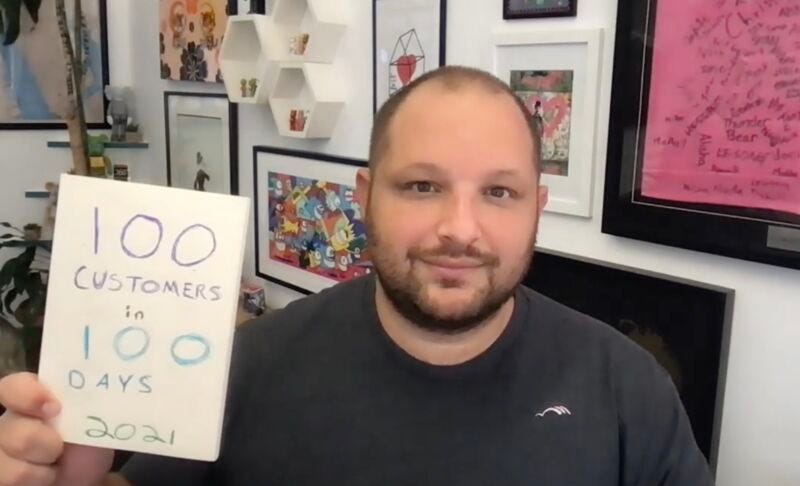
These conversations reenergized me, shaped our strategy, and reinforced that as a CEO, you need to make time for at least one customer conversation each day.
Successful tactics to consider
Because your time as CEO is limited, remember this important thing: while it is your job to meaningfully engage with at least one client every day, it is not your job to set-up that meeting.
Here are some tactics that your team can deploy in order to fill up your calendar:
Have your EA work regular dinners (ex: monthly) with customers into your schedule. Your EA should directly coordinate this with the appropriate members of your sales and success teams. Create the expectation with your team that you intend to do this on every work trip.
Have your team secure 1:1 meetings with clients and prospects for you at conferences. Your company likely sponsors or attends at least a few events per year. While it is not your job to work the booth, you should always attend the events your customers do. Have the team find a meeting room or space at the event site where you can have a quiet, intimate conversation.
Give your team a quota to bring you into meetings. While a token SPIF per meeting serves as a good incentive, the best incentives are simply the knowledge that you are available daily to be brought into these conversations, you expect people to facilitate this as part of their job, and that you are measuring this. There is also the added benefit, of course, of facetime with you.
What other tactics have you deployed as CEO to get your team to set-up meetings? Please comment below.
What others CEOs say
Nearly every CEO I speak with talks about the importance of understanding customers, and the CEO’s direct involvement in this effort. Here are some of the things I have heard in our conversations:
Jindou Lee, Founder and CEO of HappyCo, built HappyCo’s product by directly following and observing end-users—property managers and inspectors—to design software that truly met their needs. This hands-on approach led to user-friendly features like “big dopey buttons” and set HappyCo apart from enterprise software that prioritizes executive buyers over real users. He saw this customer-first mindset as their “secret sauce.”
Phil Fernandez, Former Co-Founder and CEO of Marketo, says that his company was focused on making customers successful, solving their problems, and learning from them. He also shares that their sales mantra was to never to "mix it up" with competitors, but to focus on the customer.
Ryan Westwood, CEO of Fullcast, explains that he focuses on deeply understanding his clients. As part of this effort, Westwood has personally spoken with over 60 VPs of Revenue Operations across 1:1 and group settings to gather firsthand insights. Learnings include their status as unsung heroes, inconsistency in reporting structures, and their role in the organization.
Diego Oppenheimer, Former Founder and CEO of Algorithma, stresses a CEO’s dedication to understanding their customer's problems and caring. He notes that people want to talk to the CEO and see that they are still involved, willing to listen to their problems and share their perspective. He also says that he learned a big lesson in the go-to-market world: just shut up and listen for a while, then create environments where people want to talk.
John Fazzolari, Co-Founder and Co-CEO of Revivyn, talks about how they how they met all of their early customers in person, and how that personal attention and care set them apart. He and his Co-Founder/Co-CEO Anthony Serina speak about gaining trust from listening to customers and getting feedback from them.
Nick Freund, Former Founder and CEO of Workstream, emphasizes the importance of engaging early design partners thoughtfully, prioritizing deep customer insights over immediate sales. He conducted over 50 interviews before launching, using these conversations to refine his product. He maintained open communication through Slack and regular check-ins.
Rich Buery, CEO of Robinhood, emphasizes the importance of incorporating insights from people with lived experience. One of the key ways they achieve this is through the Design Insight Group, a diverse database of approximately 3,000 individuals who provide real-world feedback to entrepreneurs.
As your company grows, many things will pull you away from direct, meaningful customer interactions. Never forget that this is your most important job as CEO.
Your direct relationship with clients will breed lifetime customer loyalty and trust. Your direct conversations will ensure you truly understand customers, and that you can build a company, culture and product that serves their needs.